Computing Integer Roots of Complex Numbers

Polar coordinates give us a really nice way to find a principal root for any nonzero complex number

Z=x+iy=Reiθ. Z = x + iy = Re^{i\theta}.

One (principal) solution can be found as z1=reiϕz_1 = re^{i\phi}, where r=Rnr=\sqrt[n]{R} and ϕ=θn\phi = \frac{\theta}{n}. This is a solution because

(reiϕ)n=rnei(nϕ)=Reiθ. (re^{i\phi})^n = r^n e^{i(n\phi)} = R e^{i\theta}.

Furthermore, any other root z2z_2 must be z1z_1 times an nnth root of unity, since

(z2z1)n=(z2)n(z1)n=ZZ=1. \left( \frac{z_2}{z_1} \right)^n = \frac{(z_2)^n}{(z_1)^n}=\frac{Z}{Z}=1.

Thus, z2=z1eiψz_2 = z_1 e^{i\psi}, where ψ\psi is a multiple of 2πn\frac{2\pi}{n}.

When Z=0Z=0, the only root is z=0z=0.

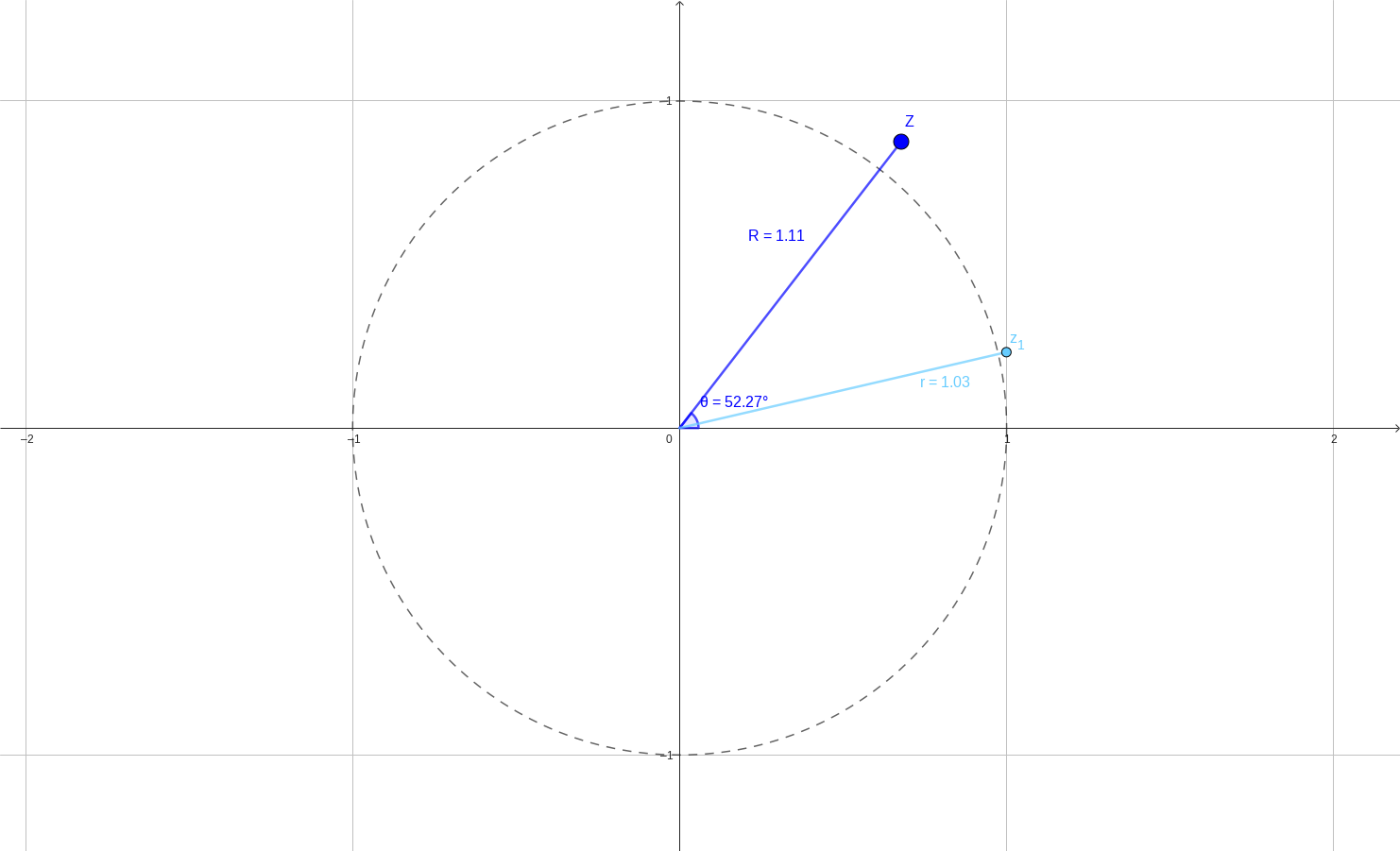
In the diagram, you can see the principal nnth root of a complex number ZZ. The argument is taken in [0,2π)[0,2\pi) for ZZ.

Check the box to see the other nnth roots.

Figure 1. Complex Roots
Look at the modulus and angle of $z_1$ compared to $Z.$
Look at the modulus and angle of z1z_1 compared to Z.Z.


For n>1n>1, drag ZZ across the positive real axis and you will see why this principal-root function is not continuous there.

Student sign in

Enter your approved student email to receive a secure magic link.